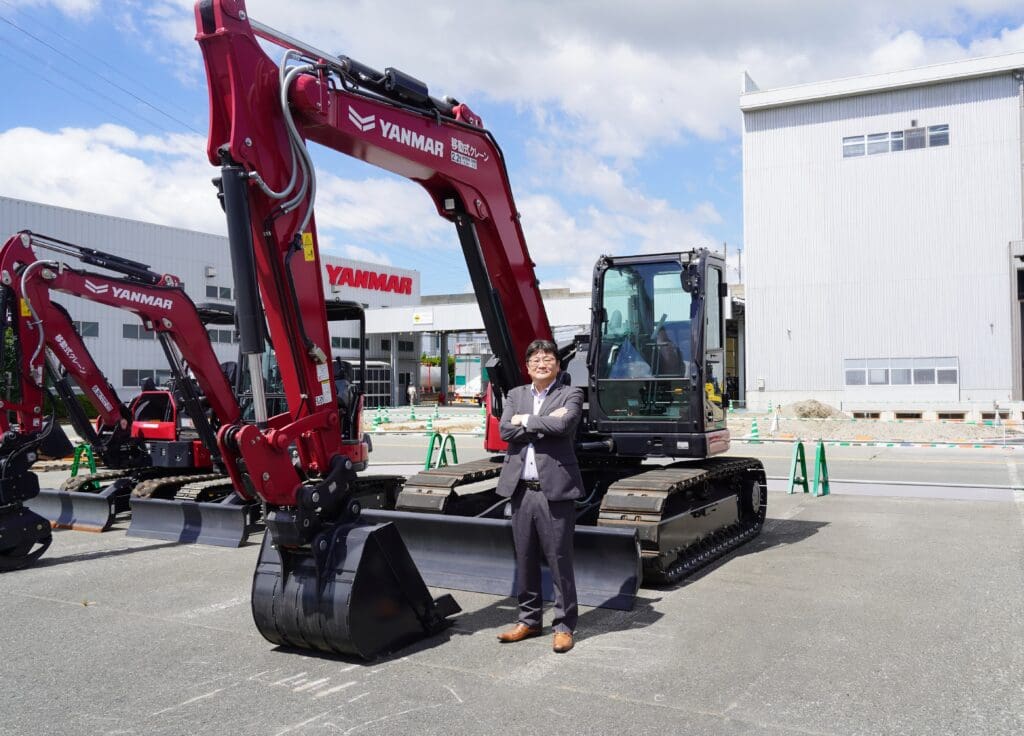
As compact equipment becomes more intelligent, Ryu Kudo, CEO of Yanmar CE, believes the industry needs to look beyond capability alone. The real test is the return technology delivers over the working life of the machine.
A friend of Ryu Kudo recently bought a premium car filled with technology neither of them entirely understood. When Kudo reached toward one of the controls, his friend quickly stopped him. “No, no, don’t touch it!”
The story still makes him laugh, though as CEO of Yanmar Compact Equipment (Yanmar CE) he also recognizes a familiar challenge. Machines can now offer levels of intelligence and automation that would have seemed extraordinary only a few years ago. Yet another function does not automatically make a machine more useful, and it rarely makes it cheaper.
For Kudo, the real cost of a compact machine extends well beyond the figure on the invoice. It is what it takes to put the machine to work and keep it productive over many years, and how much value it still holds when the first owner moves it on. “The most important point is total cost of ownership,” he explains. “How much can our customers and partners pay, and how effectively does the technology reduce their costs?”
It is a perspective shaped by experience. Growing up in Hokkaido, Japan, he watched his parents build a construction business before spending 21 years with a major US construction equipment manufacturer, moving from machine design into customer support. Having seen machines from both the drawing board and the customer’s side, he judges new technology by what it delivers in the field.
Choosing what adds value
Kudo is candid that the industry has not always been selective. “We used to add new functions whenever customers asked for them, but some customers want them and others don’t,” he says. “Over the past ten years, as new technology has been added, prices have increased year by year and model by model. That is not good for our customers.”
The answer, in his view, is greater choice. Some customers need straightforward, affordable machines. Others will benefit from more advanced technology, provided it earns its place and does not make the equipment harder to use. “If we add new technology, it must not make operation more complicated,” he adds. “A reasonable price is also required.”
The premium has to be justified somewhere in the ownership cycle, whether through the work the machine does today or the value it retains later.

Where technology makes the difference
One of the clearest cases for automation today is the shortage of skilled labor. Turner & Townsend’s 2026 Global Construction Market Intelligence report found skills gaps in more than 70% of the 112 markets it tracks, echoing what manufacturers are hearing directly from customers. “When we talk with our customers, their first problem is the lack of labor,” Kudo notes. “It is very difficult to hire experienced people.”
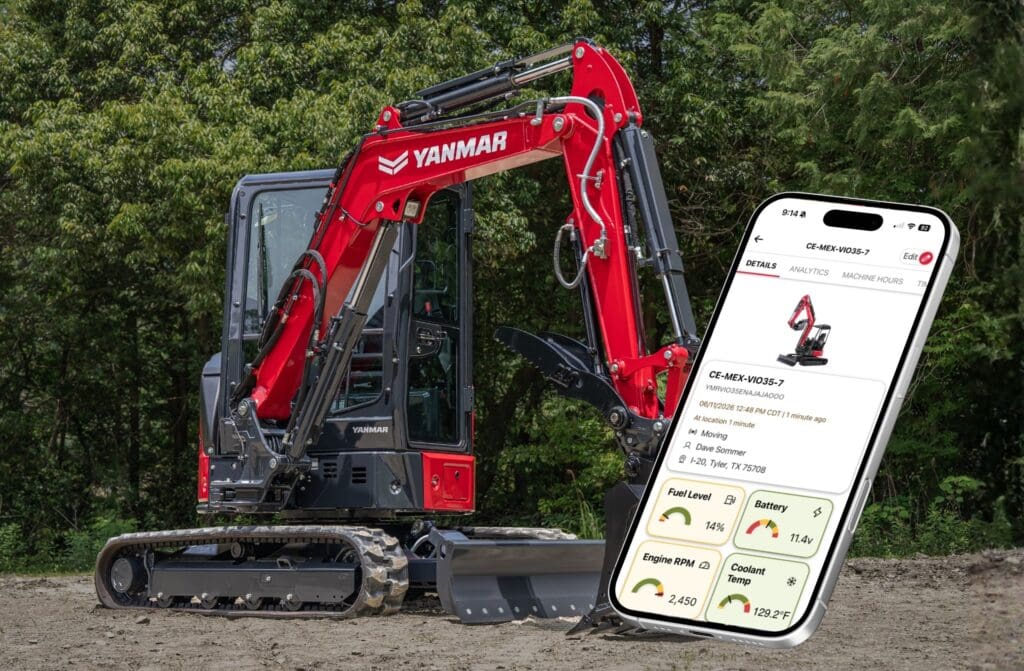
Horizontal leveling shows how technology can help. The task requires simultaneous operation of the boom, arm and bucket, something less experienced operators can find difficult. Assist functions carry part of that skill into the machine and help newer operators become productive sooner. The same thinking extends to straight-line travel and repeatable movements.
Full autonomy is a different equation. Compact equipment often works in cities and residential areas, where detailed manual work remains part of the job. “A fully autonomous machine costs almost five times as much as the original machine,” Kudo explains. “So we are carefully selecting which kinds of autonomous functions our compact equipment really needs.” For now, the emphasis is on automating the parts of the job where technology can make difficult work easier at a cost the customer can justify.
The calculation also varies between markets. Where experienced labor is scarce and expensive, automation can make a persuasive financial case. In India, by contrast, Kudo estimates that one premium machine can cost as much as employing 20 or 30 people. The same technology can carry very different value depending on where and how the machine is used.
When the machine outlives the technology
The next opportunity lies in how technology holds up over time. Compact equipment is built for a long working life, while digital technology develops much faster. Increasingly, the machine and the technology inside it are running on two different clocks. The used market shows this most clearly, where larger machines with semi-autonomous functions or 3D guidance can command a premium when new, yet second-hand they may sell for little more than a standard machine. “By the time they are sold second-hand, that technology is already old,” Kudo points out.
Autonomous operation that once worked to a tolerance of four or five centimetres now works to around 10 millimetres on new machines, even though older equipment may still have years of productive work ahead. As performance advances, technology that once justified a premium can become less attractive to the next owner.
Electric equipment adds another dimension. After five or ten years, battery capacity can fall to around 70% of its original level, making battery condition an increasingly important consideration in the used market. For manufacturers, that means thinking much earlier about what happens when the technology ages faster than the machine around it.
“We may need to buy those machines back, replace the battery and sell them to new customers as refurbished machines,” Kudo says. Used batteries may then find a second life in less demanding applications, extending their usefulness beyond the machine they were built to power.
Knowledge is power
The same life-cycle thinking applies to support. As equipment becomes more flexible and more advanced, customers need the knowledge to get the best from it. In Japan, for example, more operators are switching between attachments such as tiltrotators and breakers. “They don’t always know how to use them or how to get the most efficiency from them,” Kudo adds. Support therefore becomes part of the technology’s value from the outset, helping operators use it effectively and keep it working economically over time.
With technicians in short supply – particularly for smaller dealers and rental companies – he believes manufacturers may need to take a more active role in protecting the long-term value of the technology they introduce. Yanmar CE, for example, has started delivering service training at dealers’ own sites and is discussing manufacturer-provided maintenance with some rental businesses.
Value is the measure
That broader focus is also reflected across Yanmar. The Group’s Mid-Term Plan 2030 identifies Technology-Value Alignment as a strategic priority, bringing technological capability closer to the needs of customers. As advanced systems become more widely available, having more technology will matter less as a differentiator. What will set manufacturers apart is whether those systems continue to justify their cost long after the machine is bought, including when it changes hands.
“We need to choose carefully,” Kudo concludes, “and consider the real value of each function throughout the machine’s life.” For Yanmar CE, that also means helping dealers and customers assess where technology can deliver the strongest return for their business, and how that investment can translate into stronger performance over time.
About Yanmar Compact Equipment
Yanmar Compact Equipment (Yanmar CE) is a global leader in the design, manufacture and support of compact equipment for a range of segments, principally construction and other earthmoving applications. Its products include extensive ranges of mini and midi excavators, wheel loaders, compact track loaders and tracked carriers. These are supported by a wide range of services designed to ensure customer success. A global company with proud Japanese heritage, Yanmar CE has manufacturing facilities in Asia, Europe and North America – and an extensive international dealer network. Renowned for its innovative approach – it was the first to market with the now-benchmark mini-excavator, and is credited with popularizing the zero-tail swing concept – Yanmar CE remains a trusted brand known for its reliability, performance and commitment to customer satisfaction. These traits are demonstrated through the company’s tagline – ‘Building with you’.
For more details, please visit the official website: https://www.yanmar.com/global/construction/
About Yanmar
With beginnings in Osaka, Japan, in 1912, Yanmar was the first ever to succeed in making a compact diesel engine of a practical size in 1933. A pioneer in diesel engine technology, Yanmar is a global innovator in a wide range of industrial equipment, from small and large engines, agricultural machinery and facilities, construction equipment, energy systems, marine, to machine tools, and components. Yanmar’s global business operations span seven domains. On land, at sea, and in the city, Yanmar provides advanced solutions to the challenges customers face, towards realizing A Sustainable Future.
For more information, please visit: https://www.yanmar.com/global/about/
Valeria Iervolino
Global Brand Marketing
Yanmar Compact Equipment
valeria_iervolino@yanmar.com
+39 380 58 20 485
Aishah Baz
PR support
Daredevil
aishah.baz@daredevilpr.com

 Build & Price